

Sometimes logistics isn't simply a question of distance, mode and transit time.
Sometimes a forwarder faces a job where every next step carries risk and restrictions, and where decisions have to be made in situations that have no ready-made answer.
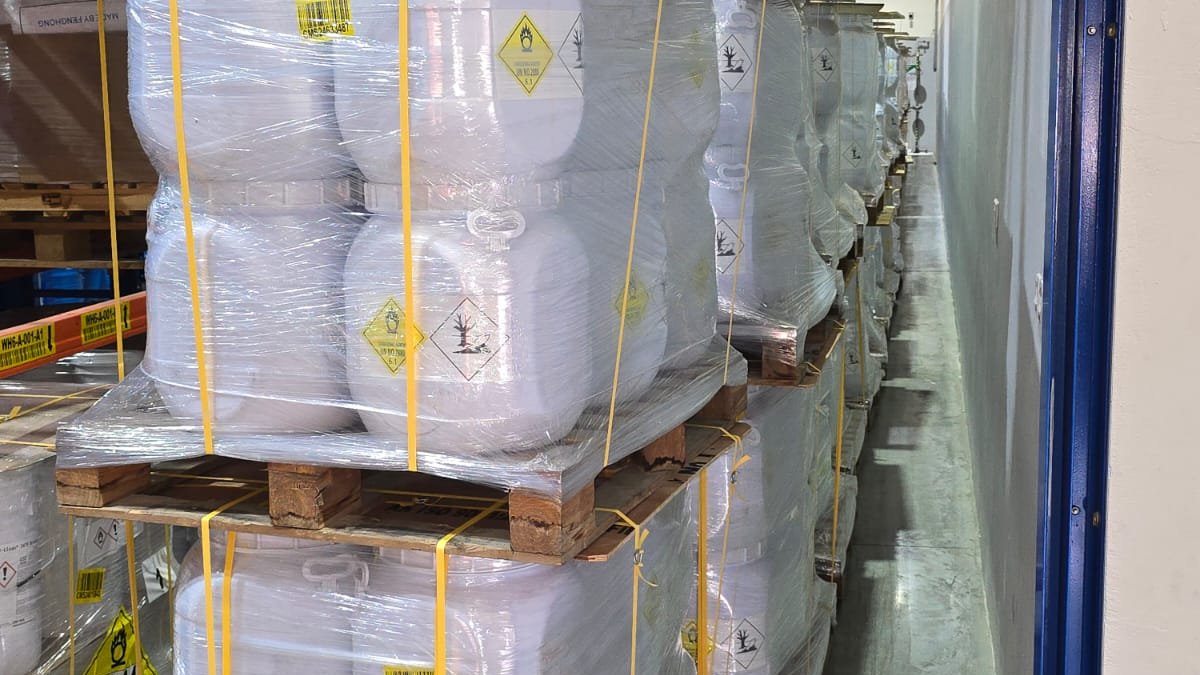
One of those projects for us was a shipment of hypochlorite, classified as class 5.1 dangerous goods.
The original plan was a sea route bypassing the Strait of Hormuz. But for a long stretch of time — because of military action, explosions and general instability in the region — the shipping lines would not give us clearance to load.
Time was running out. And with it, the deadline set by our client, Turkmenneft, was getting closer. The client expected the cargo within a fixed window, and for us that meant one thing: we had to find another option.
When the sea closes the road, you start looking overland
We switched to overland logistics.
At first glance it looked workable — there were road routes through the region. But a new problem appeared almost immediately. One of the possible routes ran through Syria, and the client ruled that out categorically because of sanctions. That path had to be excluded.
That left another option — considerably harder and riskier:
Dubai → Saudi Arabia → Jordan → Iraq → Turkey → Georgia → Azerbaijan → Turkmenistan.
On a map it was just a route. In practice it was an entirely different story.
Iraq: the leg many carriers refused
The hardest link in the chain was Iraqi territory.
The situation in the region remained unstable, and many carriers simply did not want to take on that kind of risk. The questions were especially serious around transiting the Kurdish region of Iraq.
We understood the carriers' concerns perfectly well. But we also understood something else: if we wanted to meet our obligations to the client, we had to look for a solution rather than a reason to decline.
Negotiations began. Thanks to our international contacts and years of relationships in the region, we were able to reach the right people, talk the situation through, and find a way to organise this leg of the route.
It was not an easy decision. It was a risk that had to be assessed carefully. And after all the negotiations, we decided to take that road.
Because in international logistics there comes a point where it isn't enough to tell a client "this route is impossible."
You have to ask yourself: what can we do to make it possible after all?
Step by step, as far as Turkey
Once the decision was made, the most demanding part of the work began.
The cargo had to cross Iraq and reach Turkey safely. We knew that agreeing the route was not enough on its own — we had to keep tight coordination at every stage of the movement.
Our partners were already waiting for the cargo at the Turkish border. With the support of our head office in Turkey and the international partnerships we've built over the years, we managed to get this difficult leg organised.
The cargo kept moving. And at that moment we could finally breathe out a little.
Iraq was behind us. Turkey was ahead. But it was too early to relax: the dangerous goods still had to reach the port of Mersin, where the next stage of the whole operation was waiting.
Mersin: a new customs problem
It seemed the hardest part was already over. But a fresh challenge was waiting in Mersin.
Inspecting the cargo, Turkish customs paid particular attention to its hazardous properties. In the inspectors' view the cargo posed a serious danger and could not stay as it was. A requirement came to unload it into a depot — but doing that immediately wasn't possible.
As a result the cargo had to stay on the trucks, and we were in a state of constant tension: we needed to find a solution, arrange the transfer, comply with the safety requirements, and still not derail the rest of the route.
The work began literally truck by truck. We managed to source Turkish vehicles and arrange the transfer of the cargo.
Even then the story wasn't over. After re-inspection, customs raised the next problem: in their assessment the cargo was distributed incorrectly across the trailers, and for safety it would have to be spread across three trucks instead of two.
We had planned this leg for two vehicles. Three would mean additional cost for the client and new organisational complications.
This was exactly the moment where our specialists' professionalism mattered.
The solution that kept it to two trucks
Rather than simply accepting that more vehicles were needed, the specialists at our Turkish office studied the situation closely and proposed a different approach.
The drums were carefully unpacked from the pallets and arranged in a single row, respecting the safety requirements and correct load distribution. The work was done by our people on site — carefully, without rushing, and under constant supervision.
After re-inspection, customs accepted the proposed arrangement. Three trucks were no longer required. We kept the original two-vehicle plan, met the safety requirements, and avoided the extra cost.
For us this was another defining moment of the project. Because good logistics isn't just finding a truck.
Good logistics is finding a solution when the original plan stops working.
The final stage
Once all the procedures were cleared, the cargo was transferred, processed at the port of Mersin and sent onward.
Georgia and Azerbaijan still lay ahead. Those legs passed without serious complications, and the cargo continued towards its final destination.
And finally, Turkmenistan. After a long and difficult journey, the cargo arrived safely at its destination.
A project that had been on the edge of being rerouted or falling apart several times was completed. The client was satisfied.
For our team, this project confirmed a simple truth: in international logistics you cannot foresee absolutely everything. But you can be ready to look for a solution at every stage of the journey.
From military risk and refusals from shipping lines, to an extremely difficult overland route across several countries. From an unstable situation in Iraq, to the demands of Turkish customs in Mersin. Every stage required its own decision, coordination and accountability.
We weren't looking for the easy route. We were looking for the route that would get the cargo where it needed to go. And we found it.
If you have cargo for which "the usual route" doesn't exist — tell us about it.