

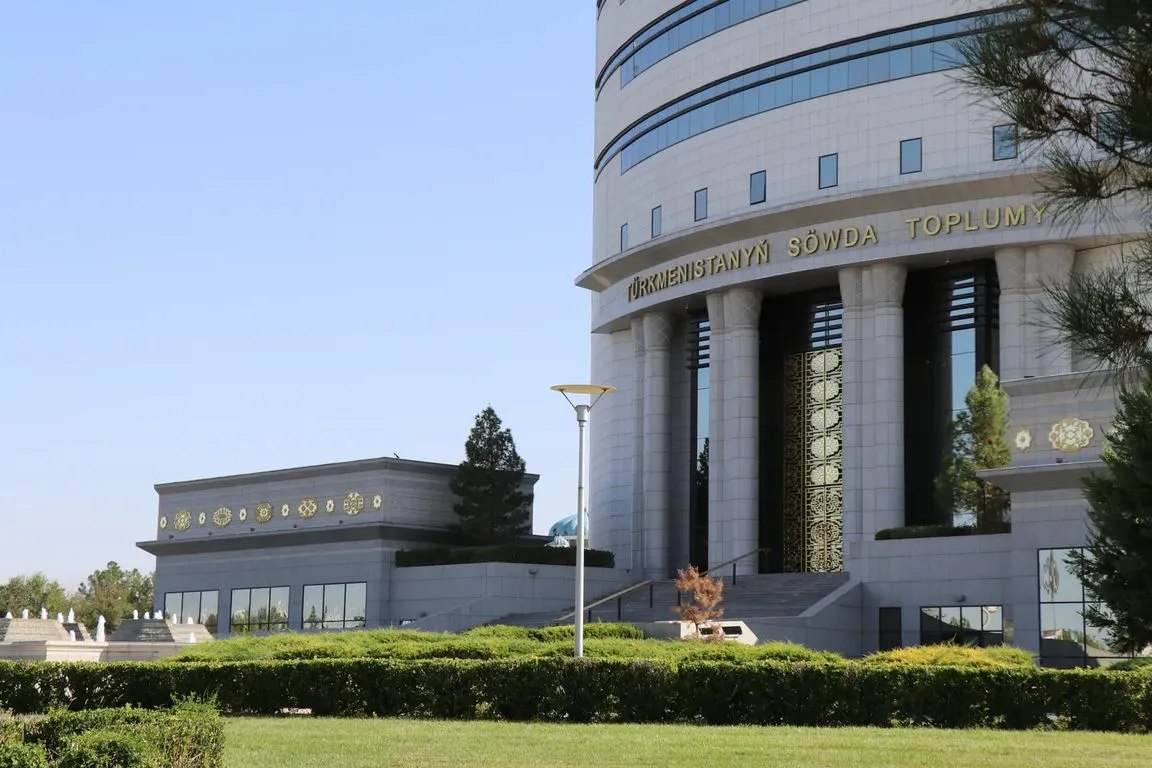
The first question most new clients ask when we mention the State Commodity Exchange: "Do we actually need this?" Short answer — if the contract is over $10,000, almost certainly yes. The long answer doesn't stop there, because registering the contract and registering your company as a supplier are two separate requirements, and almost everyone confuses them the first time around.
What the State Commodity Exchange actually is
The State Commodity and Raw Materials Exchange of Turkmenistan (often abbreviated GTSBT from its Russian name) was established by presidential decree back in 1994, and since then has functioned as the main state body through which nearly all of the country's foreign trade operations pass. It isn't an exchange in the usual sense of buyers and sellers meeting — for most shipments into Turkmenistan it's effectively a checkpoint: without registration at the Exchange, your contract formally doesn't exist as far as Turkmen customs is concerned, which means the cargo physically cannot clear the border.
The Exchange's operation is governed by a dedicated law, "On Commodity and Raw Materials Exchanges and Exchange Trading," with the Cabinet of Ministers setting the specific list of goods subject to registration and the exchange fee amounts.
The $10,000 threshold
Turkmenistan's official trade portal — run by the Ministry of Trade and Foreign Economic Relations, built with support from the relevant UNCTAD programme — states the threshold plainly: contracts exceeding $10,000 USD require registration at the Exchange. This applies equally to import and export contracts.
Below that amount, registration at the Exchange isn't formally required (other customs procedures still apply, of course). Above it, registration stops being a recommendation and becomes a condition.
The two requirements almost everyone confuses
This is where the most common mistake happens. Registering the contract is only half the picture. Since June 9, 2017, under Presidential Decree No. 252, Turkmen companies importing goods from abroad have been required to separately register the supplier company itself at the Exchange — meaning your company, as the seller. Your company has to be registered as a supplier at the Exchange before the contract itself can be registered, and that requirement remains in force today.
- Letter addressed to the Exchange chairman
- Founding and registration documents
- Same document set as CIS companies
- Plus share certificates confirming ownership stakes in registered capital
What happens if you skip it
The most common scenario we see with new clients: the cargo's already moving, paperwork was rushed, and the Exchange registration either got forgotten or someone assumed it would somehow sort itself out. It doesn't. Turkmen customs will not clear cargo against an unregistered contract, no matter how correctly every other document is filled out. The cargo just sits at the border until registration is sorted — and a day at the border costs money every single day.
Want to bid at auctions directly? You'll need company legalization
Everything above covers registering a contract you've already signed. But if your goal isn't a one-off shipment but direct participation in GTSBT auctions — for example, to purchase goods from Turkmenistan — a separate procedure applies: legalizing your company in Turkmenistan.
In practice, this is a review of your company by the Turkmenistan state. It requires a full set of your company's founding documents, and the requirements are strict: copies must be notarized, and also translated and certified into Turkmen. The package includes, among other things, a document confirming your company's registration, its charter, and — required in every case — a notarized power of attorney in the name of your company's representative in Turkmenistan.
If, alongside legalization, you also want a brokerage seat at the Exchange (the right to participate in auctions directly, rather than only registering individual contracts), the document package needs to be prepared in two full sets — one for company legalization, a separate one for the brokerage seat.
The official fees involved:
- Company legalization — $300 USD (payable at banks in Turkmenistan)
- Brokerage seat — $10,000 USD per year
- Deposit — $150,000 USD for petrochemical products, $100,000 USD for other categories of goods
We can take this on as well — from preparing and legalizing the document package to representing your company's interests in Turkmenistan when purchasing goods through the Exchange.
How we handle this
We have our own office in Ashgabat, not an arrangement with a local partner on paper — which means we handle both the supplier registration and the contract registration directly, not through a third party with unpredictable timing. For the client it's simple: you send the contract, we tell you exactly what your specific case needs, and we handle it in parallel with organising the shipment itself — not after the cargo is already stuck at the border.
The same applies to company legalization for auction participation and setting up a brokerage seat — we regularly handle this kind of registration and representation for foreign companies across Central Asia, including preparing and notarizing document packages, and can take on the whole process from the first letter through to a completed registration.
If you're planning a shipment to Turkmenistan and aren't sure whether your contract falls under mandatory registration — tell us about it and we'll work it out together.