

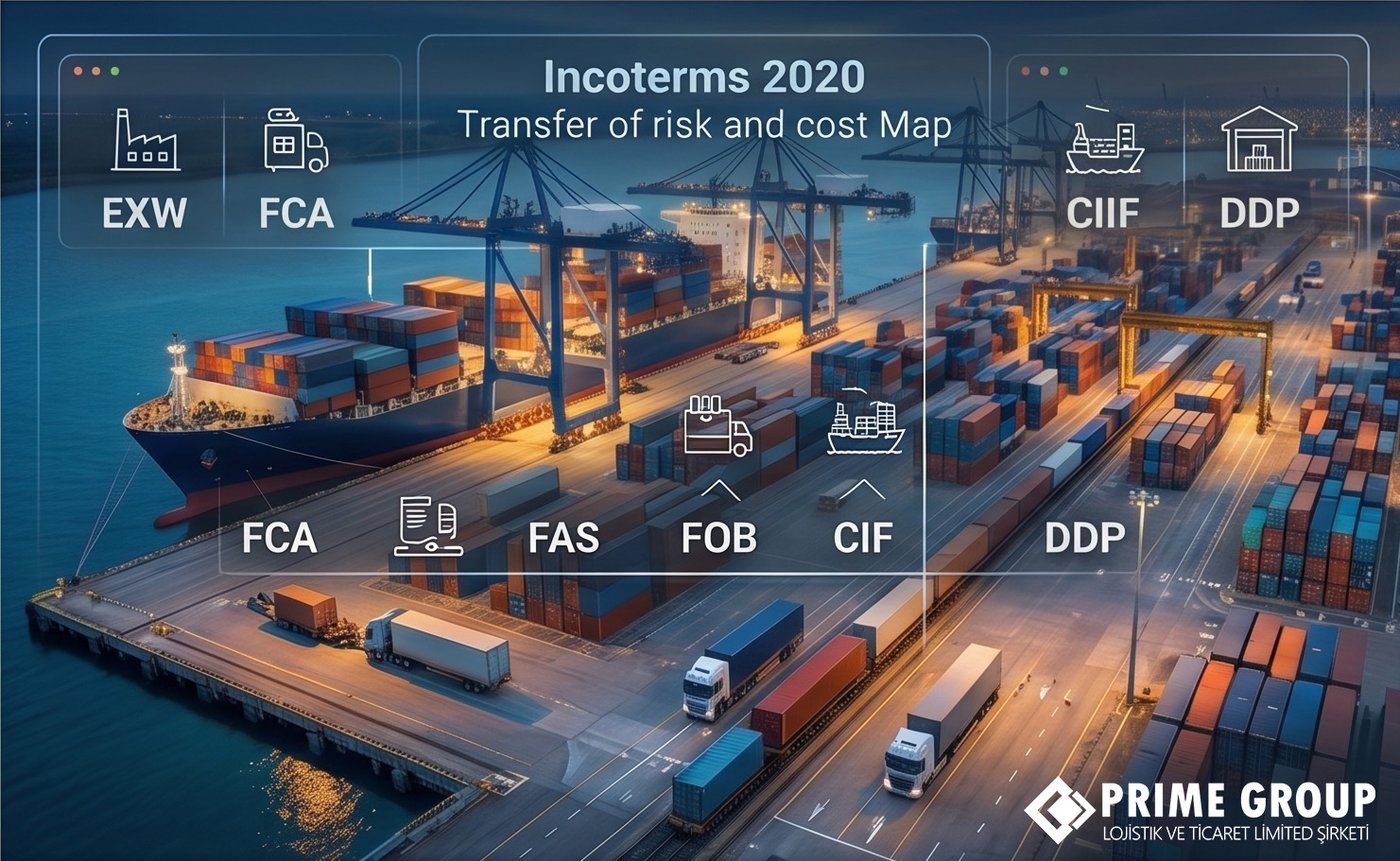
Eleven three-letter codes decide which side — seller or buyer — pays for carriage, who insures the cargo, and, most importantly, exactly where along the route responsibility for the goods passes from one to the other. We move containers every day and see the same mistake constantly: people conflate "who pays" with "who carries the risk" — two different questions, and in four of the eleven rules the answers don't match.
Risk ≠ Cost
Under CPT, CIP, CFR and CIF the seller pays for carriage all the way to the destination, but risk of loss passes to the buyer much earlier — as soon as the goods are handed to the first carrier. This is the single most common source of disputes.
11 rules, 2 groups
Seven rules work for any mode of transport, including multimodal. Four apply only to sea and inland waterway transport, where there's a clear "on board" moment.
Read the diagram left to right
The navy segment is the seller's zone of responsibility, teal is the buyer's. The gold marker shows the exact point risk transfers.
The seller simply makes the goods available at their own premises — not even loaded, and without clearing export. Everything else, including loading at the seller's own warehouse, falls to the buyer. Cheapest for the seller on paper, riskiest for a buyer who has no agent in the seller's country.
The seller clears export and hands the goods to a carrier nominated by the buyer, either at the seller's premises or another agreed place. The most common, best-balanced rule for containerised cargo — including in cases where FOB used to be used for containers out of habit, which is technically wrong (FOB is for break-bulk sea cargo, not containers).
The seller pays for carriage to the named destination — but risk passes to the buyer as soon as the goods are handed to the first carrier, not when they arrive. This is the single most misunderstood point in all of Incoterms.
Same split as CPT, but the seller must insure the cargo to a higher standard (Institute Cargo Clauses A) for the whole journey — unlike CIF, which only requires minimum cover.
The seller delivers to the named place and carries the risk until then — but does not unload and does not pay import duties. Unloading and customs clearance fall to the buyer.
The only rule where the seller is obliged to unload the goods at destination. Formerly called DAT (Delivered at Terminal); the 2020 revision renamed it and extended it to any agreed place, not just a terminal.
The seller takes on everything, including import clearance and duties in the buyer's country. Maximum obligation and risk for the seller — used rarely, and only sensibly when the seller genuinely understands the buyer country's customs procedures.
The seller delivers the goods alongside the vessel at the port of shipment — on the quay or a barge. Risk passes to the buyer from there. Used almost exclusively for bulk and break-bulk cargo.
The seller loads the goods on board the vessel nominated by the buyer. Risk passes once the goods are on board. Note: FOB is technically the wrong rule for containerised cargo — containers are usually handed over at a terminal well before loading, so FCA is the correct choice there.
The seller pays freight to the port of destination, but risk — as with FOB — passes at the port of shipment once the goods are on board. The same cost/risk gap as CPT.
Same as CFR, plus the seller must insure the cargo — but only to a minimum standard (Institute Cargo Clauses C) unless the contract says otherwise.
Quick reference — all 11 rules
| Code | Name | Transport | Risk transfers | Insurance |
|---|---|---|---|---|
| EXW | Ex Works | Any | 3% | Buyer |
| FCA | Free Carrier | Any | 18% | Buyer |
| CPT | Carriage Paid To | Any | 18% (Seller 85%) | Buyer |
| CIP | Carriage and Insurance Paid To | Any | 18% (Seller 85%) | Seller |
| DAP | Delivered at Place | Any | 85% | Negotiable |
| DPU | Delivered at Place Unloaded | Any | 92% | Negotiable |
| DDP | Delivered Duty Paid | Any | 97% | Seller |
| FAS | Free Alongside Ship | Sea | 22% | Buyer |
| FOB | Free On Board | Sea | 27% | Buyer |
| CFR | Cost and Freight | Sea | 27% (Seller 85%) | Buyer |
| CIF | Cost, Insurance and Freight | Sea | 27% (Seller 85%) | Seller |